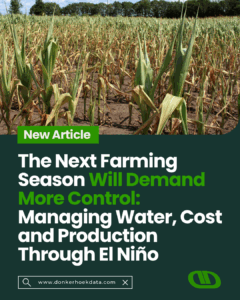
South African agriculture has never been unfamiliar with difficult weather. But as a strong El Niño develops through 2026, the margin for guessing is becoming increasingly smaller.
The World Meteorological Organization reported in July 2026 that a strong El Niño is developing and is expected to strengthen through August to October, alongside an increased likelihood of above-normal temperatures across large parts of the world. El Niño is also associated with significant changes in rainfall patterns and an increased drought risk in certain regions.
For South African agriculture, the exact effect will vary considerably according to region, crop and rainfall system. El Niño has historically been particularly important for South Africa’s summer-rainfall production regions, where stronger El Niño events are often associated with below-average rainfall and increased heat. Previous El Niño-related drought conditions across Southern Africa have resulted in significant reductions in crop production.
The Western Cape presents a more complex picture because much of the province falls within a winter-rainfall system. El Niño does not automatically mean below-average Western Cape winter rainfall. However, producers across areas such as the Swartland already understand the consequences of combining limited water availability with high temperatures and increasing evaporation.
And that is where the real agricultural risk lies.
Higher temperatures increase crop water demand.
When water resources are already under pressure, every unnecessary irrigation cycle becomes expensive. At the same time, insufficient irrigation at the wrong stage of crop development can negatively affect yield, quality and ultimately farm income.
Water therefore needs to be managed as an inputnot simply as something that is available until the dam, borehole or allocation begins running low.
The same applies to fertiliser, chemicals, labour, electricity, fuel and every other input required to produce a crop.
A difficult production season does not necessarily mean that every farming operation becomes unprofitable.
It does, however, mean that inefficient farming becomes far more expensive.
The next 12 to 24 months should therefore be treated as a risk-management period in which producers need much clearer information about two things:
How efficiently are we using our water?
And:
What is it actually costing us to produce each block?
Donkerhoek Data provides tools to help farmers answer both.
One of the technologies available through Donkerhoek Data is the AquaCheck Soil Moisture Management System.
AquaCheck soil moisture probes continuously measure soil moisture and soil temperature at different depths within the soil profile. Depending on the probe configuration, multiple sensors can monitor what is happening throughout the crop’s root zone rather than simply measuring conditions at the surface.
This gives the farmer a much clearer picture of what happens after irrigation.
How deeply did the water penetrate?
How quickly is the crop using that water?
Is moisture reaching the active root zone?
Is irrigation running for longer than necessary?
Is the soil drying out faster than expected?
Does irrigation need to start now, or can it safely wait?
AquaCheck’s system can provide information including current soil moisture and temperature, infiltration rate, irrigation and fertigation depth, daily water consumption, irrigation timing and irrigation recommendations.
That transforms irrigation from a schedule based largely on habit or assumption into a management decision supported by actual soil data.
Because both over-irrigation and under-irrigation carry a cost.
Under-irrigation can place the crop under unnecessary stress and negatively affect yield or quality.
Over-irrigation can waste water, electricity and pumping capacity, while potentially moving water — and nutrients — beyond the effective root zone.
When water availability becomes increasingly important, the objective isn’t simply to irrigate less.
The objective is to irrigate correctly.
And that requires knowing what is happening below the soil surface.
Saving water means very little if the farmer still doesn’t know what the crop is actually costing to produce.
During a high-risk season, input costs become just as important as production volumes.
A block may produce an impressive crop and still deliver an unsatisfactory margin if its labour, chemicals, fertiliser, fuel and other production costs have climbed too high.
This is where Donkerhoek Data’s Farm Management Software becomes particularly valuable.
The Costing Module allows producers to analyse costs individually for each block on the farm.
Costs generated through spray and fertiliser instructions can automatically form part of the costing structure. Donkerhoek Data’s Payroll system can also integrate with costing, allowing employee hours and labour costs to be allocated to specific blocks or cost centres. Contractor expenses and other general costs can also be captured and allocated.
Instead of only knowing what the entire farm spent during the season, management can begin asking far more useful questions.
What did Block 14 actually cost us?
How much fertiliser went into it?
What did the spray programme cost?
How much labour was allocated to it?
What were the contractor costs?
What was the total production cost?
And, most importantly:
What did that block earn in relation to what we spent on it?
Donkerhoek Data’s Income Module can combine costing information with income data to generate Cost & Income profitability reporting by block or variety.
That information becomes extremely powerful when production conditions become more difficult.
Consider a simple principle.
If a block normally produces 50 tonnes and its total production cost is R500,000, that production cost equates to R10,000 per tonne before other downstream expenses are considered.
If difficult conditions reduce production to 40 tonnes while the farmer still spends R500,000, the cost has effectively increased to R12,500 per tonne.
Nothing had to become more expensive for the crop to become more expensive to produce.
Yield dropped.
This is precisely why knowing only the total farm expenditure is no longer enough.
When production is under pressure, farmers need to understand profitability at the level where production decisions are actually made, the block.
It allows management to identify where costs are increasing, where resources are being used inefficiently and where intervention is required before the end of the season.
The technology itself is not the end goal.
Better decisions are.
An AquaCheck probe will not make it rain.
Farm Management Software cannot reduce the temperature.
Neither can guarantee a higher yield during a difficult season.
What these systems can do is provide management with substantially better information about the resources that remain within their control.
You can control how efficiently available irrigation water is applied.
You can control whether unnecessary irrigation cycles are taking place.
You can monitor what each block is costing.
You can identify where labour, spray and fertiliser expenses are accumulating.
You can compare production cost against income.
And you can make changes while there is still time to make them.
The developing El Niño is another reminder that climate volatility is becoming an increasingly important part of agricultural planning.
Farmers cannot manage rainfall.
They cannot manage regional temperatures.
And they cannot manufacture additional water when resources run short.
But they can improve how precisely available water, labour and inputs are managed.
For the coming production seasons, the farms best positioned to protect their margins will increasingly be those that know exactly what is happening, above the soil, below the soil and inside the numbers.
Measure your water.
Know your cost.
Protect your production.
Donkerhoek Data offers AquaCheck Soil Moisture Management solutions together with integrated Farm Management Software designed to give South African producers the information they need to make better management decisions.
Because when water becomes scarce and margins become tighter, guessing becomes expensive.ore it ends.




Please fill out the form below, tell us which products you are interested in and we will make sure the closest Donkerhoek Data agent in your area gets in contact with you.
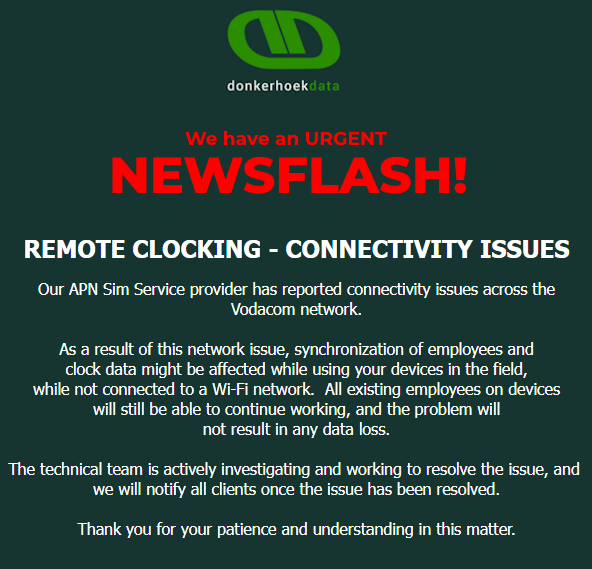
Please note that we are currently experiencing problems with submissions on our website. If you need to complete any Request Form or Contact Form on our website (or if you have done so in the last 24 Hours), please contact our Support Team directly via support@donkerhoekdata.co.za or on 021 874 1047.
Thank You for your patience and understanding.
Our telephone service provider is experiencing technical difficulties
and as a result, our telephone system is currently offline.
To contact us via email, please send us an email to support@donkerhoekdata.co.za.
Alternatively, if you have a mobile device or a laptop with a headset, connected to the internet, you can call us via VOIP.
After closing this Pop-Up screen, simply click on the ‘Chat’ button at the bottom right of the screen, and click on “Call Us”.
We apologise for any inconvenience, and thank you for your patience and understanding.
Our telephone service provider is currently experiencing technical difficulties, and as a result our telephone system is offline.
For assistance, please send us an email to support@donkerhoekdata.co.za or use the Chat option on our website.
We will get back to you as soon as possible. We apologize for any delays or inconvenience experienced.
Thank you for your patience and understanding.
Our E-mail Service Provider is currently experiencing technical problems, affecting the delivery of both our incoming and outgoing e-mails.
Please bear with us while the technicians are hard at work, trying to resolve the problem ASAP.
Thank you for your patience and understanding.